
Excess Business Loss Limitation
Excess Business Loss Limitation (§461(l)): Why Your STR Loss May Not Fully Offset W-2 Income in 2026
By: Dominic Springer | October 14, 2026
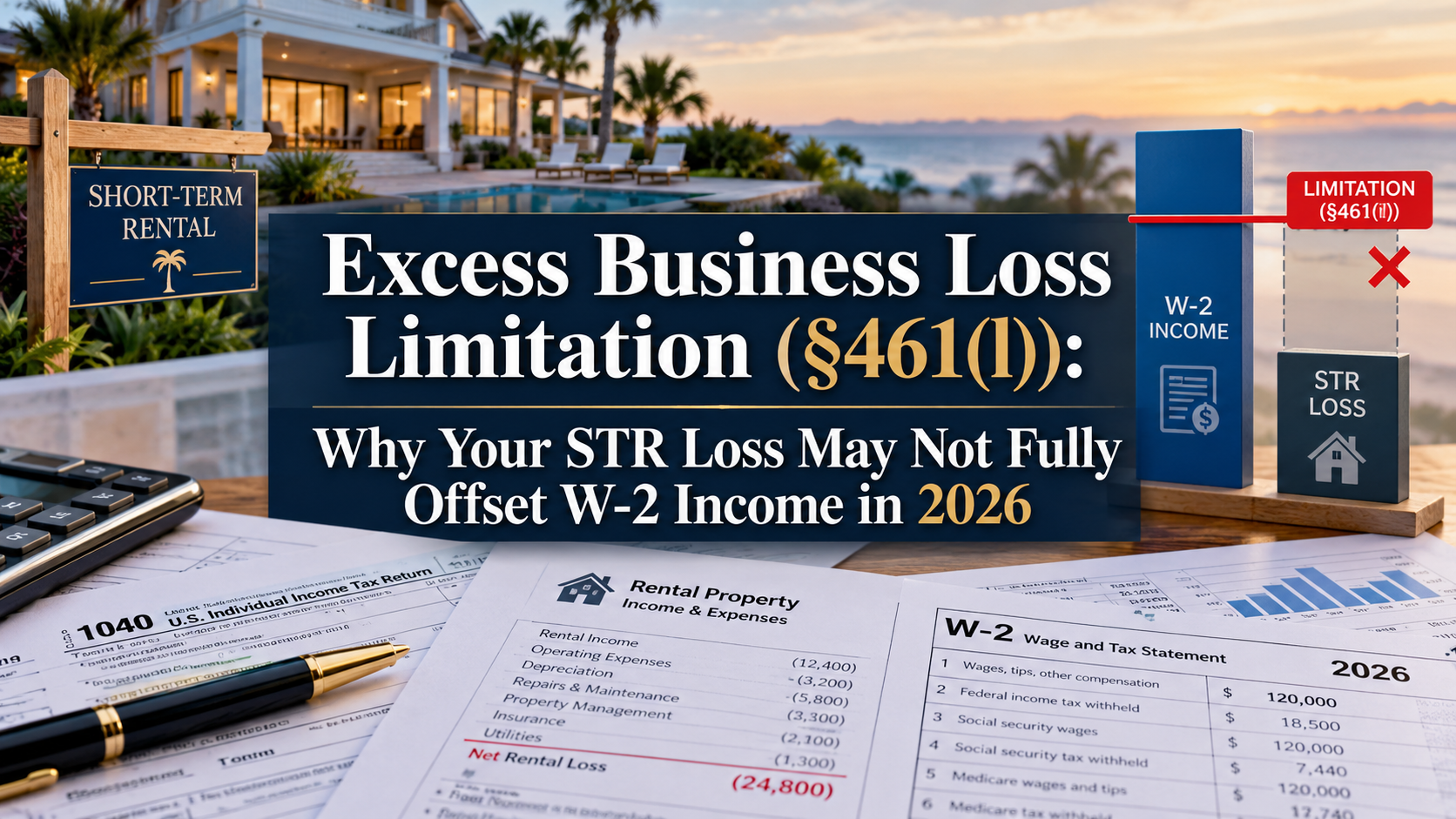
Excess Business Loss Limitation (§461(l)) in 2026: How STR Losses Affect W-2 Income
A short-term rental can generate a substantial tax loss through operating expenses, cost segregation, and accelerated depreciation. For high-income investors, that loss may help reduce taxable W-2 income.
But even if you materially participate in your rental business, you may not be able to deduct the entire loss in the current year.
That's because the excess business loss limitation under Section 461(l) places another restriction on certain business deductions.
For 2026, the limitation is especially important. The federal threshold has decreased to $256,000 for individual filers and $512,000 for married couples filing jointly.
An investor generating a $400,000 nonpassive short-term rental (STR) loss could therefore have a portion of that deduction disallowed, even after satisfying the material participation rules.
The good news? The disallowed amount generally isn't lost. It becomes a net operating loss (NOL) carryforward that may provide future tax benefits.
Understanding how these rules interact is essential before assuming a large STR loss will eliminate a significant portion of your salary-related taxable income.
TL;DR: What STR Investors Should Know
- Nonpassive doesn't mean unlimited. An STR loss may qualify as nonpassive while still facing the Section 461(l) limitation.
- 2026 thresholds decreased. The limits are $256,000 for individual filers and $512,000 for married couples filing jointly.
- W-2 wages are excluded from business income when calculating the excess business loss limitation.
- REPS doesn't bypass Section 461(l). Real Estate Professional Status affects passive activity treatment, not the federal excess business loss cap.
- Business income and losses are combined. Other qualifying business profits may reduce your calculated excess loss.
- Disallowed losses generally carry forward. Federal excess business losses become NOL carryforwards subject to applicable future-year rules.
- Depreciation timing matters. A larger first-year deduction doesn't always mean a larger immediate tax benefit.
The Loss-Limit Stack: Basis, At-Risk, Passive, Then §461(l)
Before a short-term rental loss can offset income from your job, it must satisfy several tax rules.
These limitations generally operate in sequence.
Basis and At-Risk Limitations
The first question is whether you have sufficient tax basis to deduct the loss, where entity-level basis restrictions apply.
Partnership and S corporation investors, for example, generally cannot deduct pass-through losses exceeding their available basis.
Next, Section 465 may restrict losses to the amount a taxpayer has at risk in the activity, subject to special financing rules.
A loss blocked at an earlier stage generally cannot simply bypass those restrictions.
Passive Activity Limitations Under Section 469
The next question is whether the activity is passive or nonpassive.
Under passive activity loss rules, passive losses generally cannot offset nonpassive income, including W-2 wages.
However, certain STR operations may qualify for exceptions to the usual rental activity classification.
If the STR qualifies as a trade or business and the taxpayer materially participates, the resulting loss may be nonpassive.
The Non Passive Loss Limitation Under Section 461(l)
This is the additional limitation investors frequently overlook.
Even when an STR loss is nonpassive and survives the earlier restrictions, Section 461(l) may limit how much can be deducted during the current tax year.
The IRS applies this rule to qualifying business deductions and income at the taxpayer level.
That means passing the material participation test does not guarantee full deductibility.
Does Real Estate Professional Status Bypass §461(l)?
No.
Real Estate Professional Status (REPS) can affect whether certain rental real estate losses are treated as passive under Section 469.
However, qualifying for REPS doesn't automatically make every rental loss nonpassive. Material participation in the relevant activity must still be considered.
And even when the activity qualifies for nonpassive treatment, the excess business loss limitation may apply.
Importantly, certain STR owners may establish nonpassive treatment without qualifying for REPS at all.
These are separate tax rules serving different purposes.
Passive Loss vs. Excess Business Loss: What's the Difference?
| Tax consideration | Section 469 | Section 461(l) |
|---|---|---|
| Primary restriction | Passive activity losses | Excess business losses |
| Key question | Is the activity passive? | Does the combined business loss exceed the threshold? |
| Material participation | Can affect classification | Does not create an exemption |
| 2026 fixed threshold | No universal threshold | $256K / $512K |
| Disallowed amount | Generally suspended passive loss | Generally federal NOL carryforward |
| Potential W-2 offset | Restricted for passive losses | Limited for qualifying business losses |
The important difference is what happens after the loss becomes nonpassive.
Section 469 determines whether the loss may be available against other income. Section 461(l) may then restrict how much of that otherwise allowable business loss can be used immediately.
How §461(l) Works
Section 461(l) limits excess business losses for noncorporate taxpayers, including individual investors and owners of pass-through businesses.
The calculation generally combines qualifying income, gains, deductions, and losses from all of the taxpayer's trades or businesses.
An excess business loss arises when qualifying business deductions exceed qualifying business income and gains by more than the annual threshold.
In simplified terms:
Excess Business Loss = Business Deductions − Business Income − Annual Threshold
Only an amount above zero is disallowed under this simplified calculation.
The actual calculation includes special adjustments for certain gains, losses, and deductions. See IRC §461(l).
Why W-2 Wages Don't Count as Business Income
This is especially important for physicians, executives, technology professionals, and other high-income STR investors.
Section 461(l) excludes income attributable to performing services as an employee from the business-income calculation.
For example, earning $600,000 in W-2 wages doesn't mean you have $600,000 in qualifying business income available to absorb an STR loss.
However, a business loss that remains deductible after Section 461(l) may still offset taxable income attributable to wages.
The distinction is:
W-2 wages can potentially be offset by allowable nonpassive business losses, but they don't increase the business-income amount used to calculate the excess business loss.
How Section 461(l) Applies to Rental Properties
Not every rental property loss receives the same tax treatment.
Traditional long-term rental activities are generally considered passive unless an applicable exception or special rule changes the result.
Certain short-term rentals can follow a different classification process.
Under Treasury Regulation §1.469-1T(e)(3)(ii), an activity may fall outside the passive-activity definition of a rental activity when:
- The average period of customer use is seven days or less; or
- The average period is 30 days or less and significant personal services are provided, subject to the regulatory requirements.
For a qualifying STR trade or business, material participation can help establish nonpassive treatment.
But this doesn't automatically eliminate the excess business loss rental property issue.
An otherwise allowable loss must still satisfy Section 461(l).
The short-term rental tax loophole describes the interaction between rental classification, participation, and depreciation—not an exemption from every tax-loss limitation.
2026 Thresholds (and Why They Went Down)
The excess business loss 2026 thresholds are substantially lower than the corresponding 2025 amounts.
| Filing status | 2025 | 2026 | Reduction |
|---|---|---|---|
| Individual filer | $313,000 | $256,000 | $57,000 |
| Married filing jointly | $626,000 | $512,000 | $114,000 |
These figures are based on IRS Revenue Procedure 2025-32 and the previous year's inflation adjustments.
The One Big Beautiful Bill Act (OBBBA) permanently extended Section 461(l) and reset the inflation-adjustment base beginning in 2026.
That change explains why the 2026 thresholds declined rather than increasing under ordinary annual inflation adjustments.
What About Married Filing Separately?
Taxpayers filing separately should not assume they qualify for the married-filing-jointly threshold.
The regular individual threshold generally applies rather than half of the joint threshold being automatically allocated to each spouse.
For couples considering different filing statuses, the overall tax effect should be evaluated before making a decision.
The lower 2026 threshold is particularly relevant for investors expecting large depreciation deductions from newly acquired properties.
Worked Example: $400,000 STR Loss + W-2 Income
Consider a single investor with the following 2026 tax situation:
- W-2 salary: $600,000
- Qualifying nonpassive STR loss: $400,000
- Other qualifying net business income: $0
- Applicable Section 461(l) threshold: $256,000
Assume the STR is an eligible trade or business, the investor materially participates, and all earlier tax limitations have been satisfied.
Step 1: Calculate the Excess Business Loss
$400,000 − $256,000 = $144,000
The investor has a $144,000 excess business loss.
Step 2: Determine the Current Deduction
| Tax calculation | Amount |
|---|---|
| Total STR loss | $400,000 |
| Currently allowable business loss | $256,000 |
| Disallowed excess business loss | $144,000 |
| W-2 wages | $600,000 |
| Income remaining before other adjustments | $344,000 |
Under these simplified assumptions, only $256,000 of the STR loss can offset current-year income.
The remaining $144,000 generally becomes an NOL carryforward.
This is why the non-passive loss limitation matters even for investors who properly qualify for the STR tax strategy.
What if the Investor Has Another Profitable Business?
Now assume the investor also earns $150,000 of qualifying net business income.
The combined result becomes:
- STR loss: $400,000
- Other business profit: $150,000
- Net business loss: $250,000
- Section 461(l) threshold: $256,000
Because the combined net business loss is below the threshold, no excess business loss arises under these simplified assumptions.
This illustrates why Section 461(l) generally requires aggregation of qualifying business activities rather than a property-by-property calculation.
All examples are illustrative and exclude additional tax adjustments.
What Happens to the Disallowed Loss (NOL Rules)
A disallowed excess business loss generally isn't permanently lost.
Under Section 461(l), the disallowed amount becomes a federal net operating loss carryforward.
That carryforward may reduce taxable income in a future year, subject to the applicable NOL rules.
How the 80% NOL Limitation Works
Under IRC §172, most post-2017 NOL carryforwards generally cannot offset more than 80% of taxable income in the year they're used, after applicable adjustments.
Assume the investor carries forward $144,000 from 2026.
In 2027, suppose the investor has $150,000 in taxable income before the NOL deduction.
| Illustrative 2027 calculation | Amount |
|---|---|
| Available NOL | $144,000 |
| Taxable income before NOL | $150,000 |
| Maximum deduction at 80% | $120,000 |
| Remaining NOL carryforward | $24,000 |
The taxpayer generally may continue carrying forward the unused amount under current federal rules.
A future NOL deduction can still produce valuable savings, but its timing may differ from the investor's original expectations.
Can Existing NOL Carryforwards Affect Your 2026 Strategy?
Yes, but an existing NOL shouldn't simply be added to the current year's business deductions for Section 461(l).
The calculation specifically excludes deductions allowed under Section 172 and Section 199A when determining the excess business loss.
Existing NOL deductions are analyzed separately under the applicable NOL rules.
This means an investor with both a prior-year NOL and a new 2026 STR loss must evaluate how the limitations interact.
The IRS Form 461 instructions explain these exclusions and the treatment of disallowed excess business losses.
California Nonconformity: Why State Results May Differ
California generally has its own excess business loss reporting requirements and doesn't follow every federal amendment.
Under California's published guidance, a disallowed California excess business loss is generally treated as an excess business loss carryover rather than following the federal NOL treatment automatically.
California investors should separately calculate federal and state results and confirm applicable 2026 thresholds and conformity provisions.
The California Franchise Tax Board provides relevant guidance through Schedule CA instructions and Form FTB 3461.
Planning Around the Cap
Generating a large depreciation deduction can be useful, but the objective should be maximizing the actual tax benefit rather than the size of the reported loss.
Model Your Loss Before Year-End
Investors should evaluate projected W-2 income, qualifying business income, depreciation, existing carryforwards, and filing status before relying on a significant STR deduction.
The complete picture may reveal that part of the deduction will be deferred.
A year-end review can help model your loss before year-end using the applicable federal and state limitations.
Compare Cost Segregation Outcomes
Accelerated depreciation can increase early deductions, while a cost segregation study identifies assets potentially eligible for shorter recovery periods.
But a larger first-year deduction doesn't guarantee an equally large immediate W-2 offset.
Our discussion of whether cost segregation is worth it for an Airbnb illustrates why usable deductions, study costs, future income, and recapture should all be considered.
Review Bonus Depreciation and Timing
Under current federal law, certain qualified property acquired and placed in service after January 19, 2025, can qualify for 100% bonus depreciation, subject to statutory requirements.
That can create substantial deductions in 2026.
However, bonus depreciation doesn't override Section 461(l).
Investors should compare available depreciation elections, placed-in-service dates, expected future taxable income, and carryforward consequences.
They cannot arbitrarily assign depreciation deductions to whichever year is most favorable.
Consider Future Property Sales
Accelerating depreciation can also affect adjusted basis and potential gain or recapture when a rental property is sold.
Even when depreciation provides tax savings today, the investment's eventual disposition may create additional tax consequences.
This is another reason a complete projection should consider the expected holding period rather than focusing only on the first-year deduction.
Reporting on Form 461
IRS Form 461 calculates the excess business loss limitation for qualifying noncorporate taxpayers.
The process generally includes:
- Calculating qualifying business income, gains, deductions, and losses.
- Applying earlier basis, at-risk, and passive activity limitations.
- Excluding amounts that don't qualify, including employee wages.
- Applying the annual Section 461(l) threshold.
- Reporting the disallowed amount and tracking the resulting NOL carryforward.
Special treatment applies to business-related capital gains and losses. Generally, capital losses aren't included as business deductions for this calculation, while qualifying capital gains are subject to statutory limits.
Taxpayers should also exclude Section 172 NOL deductions and Section 199A qualified business income deductions from the calculation.
The IRS instructions for Form 461 provide the detailed reporting requirements.
For 2026 returns, taxpayers should follow the final 2026 instructions when issued.
Final Thoughts
The excess business loss limitation is one of the most important tax rules for high-income investors using short-term rentals to generate deductions.
Material participation and Real Estate Professional Status can influence whether rental losses are passive or nonpassive. But those rules are only part of the analysis.
Even when an STR loss becomes nonpassive, Section 461(l) may prevent the full amount from reducing W-2 income in the current year.
With lower federal thresholds in 2026, investors using cost segregation, bonus depreciation, and other tax strategies need to understand the difference between generating a deduction and using it immediately.
The most effective approach considers business income, loss limitations, carryforwards, depreciation timing, and future tax consequences together.
Frequently Asked Questions
Does Section 461(l) apply to the STR tax loophole?
Yes, potentially. An otherwise allowable nonpassive STR trade or business loss may still be limited by Section 461(l).
Does REPS eliminate the nonpassive loss limitation?
No. REPS and material participation affect passive activity treatment. They do not automatically exempt an investor from Section 461(l).
Can I offset $400,000 of W-2 income with an STR loss in 2026?
Possibly, depending on your filing status, qualifying business income, earlier tax limitations, and other circumstances. A single filer with a $400,000 qualifying net business loss and no other business income would generally face the $256,000 threshold under the simplified calculation.
Is the excess business loss permanently lost?
Generally, no. The federally disallowed amount becomes an NOL carryforward, which may provide deductions in later years subject to applicable limitations.
Does Section 461(l) apply to every rental property?
Not automatically in the same way. Rental classification, trade or business status, passive activity rules, and other tax limitations determine whether and how a rental loss enters the calculation.
Can existing NOL carryforwards increase my current business loss deduction?
No. Section 172 deductions are excluded when determining the current-year excess business loss. Existing NOLs are analyzed separately.
Does married filing jointly increase the 2026 limit?
Yes. For 2026, the joint threshold is $512,000, compared with $256,000 for an individual filer.
Can cost segregation still be beneficial when Section 461(l) applies?
Yes. But its value depends on current allowable deductions, future NOL utilization, depreciation timing, state taxes, costs, and potential recapture.