How to Prove Material Participation
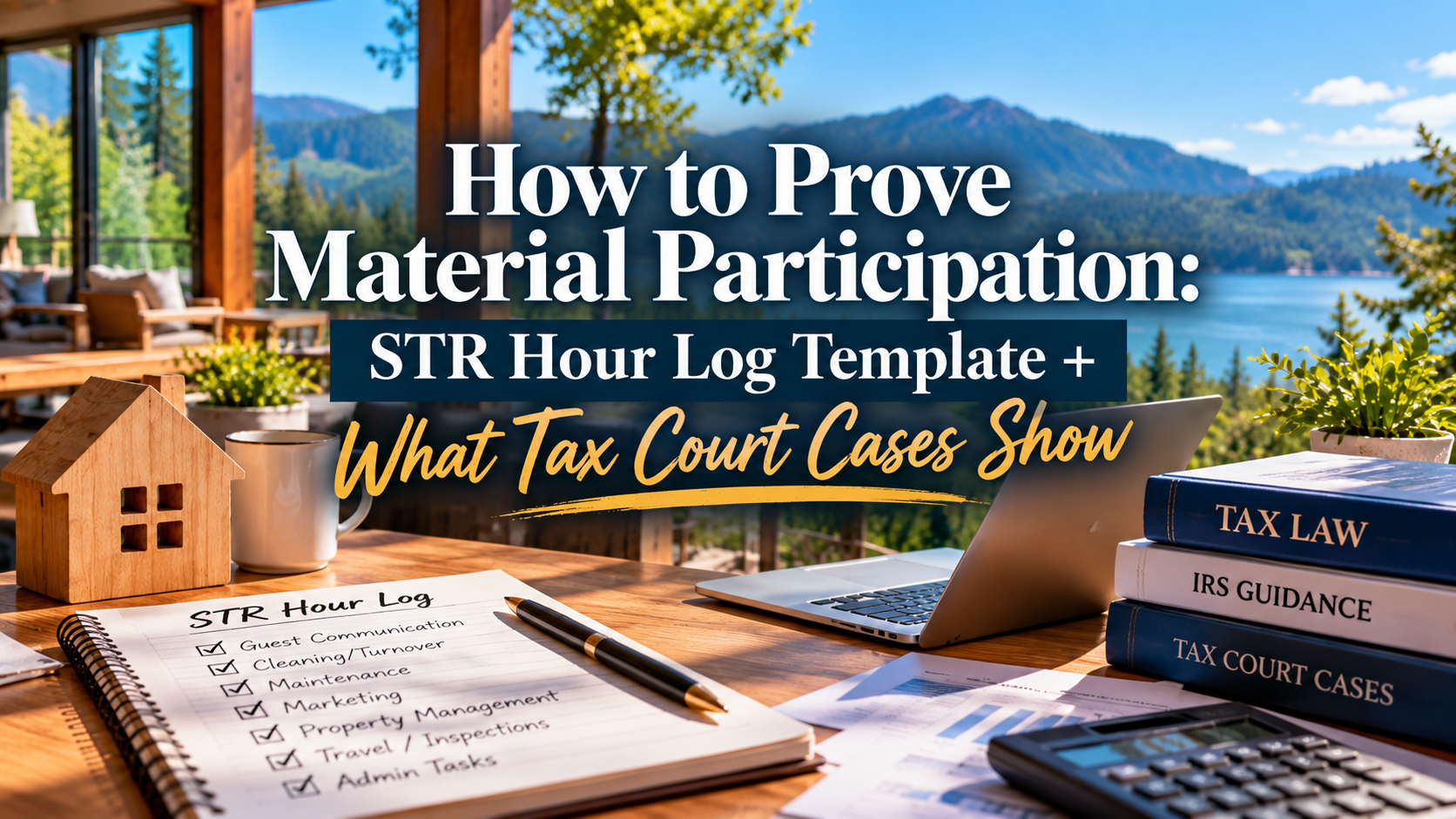
How to Prove Material Participation: STR Hour Log Template + What Tax Court Cases Show
By: Dominic Springer | October 07, 2026
Material Participation Log: STR Hour Tracking + Tax Court Lessons
To prove material participation, keep a clear record of what you did, when you did it, how long it took, which property it involved, and what evidence supports the entry.
Treasury regulations do not require a contemporaneous daily log, but reconstructed records still need to be reasonable and supported by calendars, platform messages, receipts, invoices, work orders, reservation history, and other documentation.
For short-term rental owners, a stronger documentation system generally means:
- Tracking hours by property
- Recording who performed each task
- Keeping spouse hours separately identifiable
- Documenting cleaners, co-hosts, property managers, and other participants when their hours matter
- Avoiding vague entries and unsupported round-number estimates
- Separating operational work from investor-type activity and personal time
- Preserving source records that corroborate significant entries
- Reviewing participation before year-end instead of rebuilding the entire year during tax preparation
Your records should support the material participation test your facts actually satisfy, not be constructed simply to reach a desired 100-hour or 500-hour threshold.
For the complete explanation of the seven tests, see Surge's guide to material participation tests.
Important: This article is for general educational purposes only and does not constitute individualized tax, legal, or accounting advice. Material participation is highly fact-specific. All examples are illustrative. A qualified CPA, EA, or tax attorney should verify applicable tax treatment, figures, court citations, regulatory interpretations, and documentation strategy before a return is filed.
For a short-term rental owner, there is a major difference between saying you worked hundreds of hours on a property and being able to prove those hours.
You may genuinely spend significant time answering guest questions, coordinating cleaners, managing reservations, changing pricing, purchasing supplies, solving maintenance problems, supervising vendors, and handling other operating tasks.
But if the tax treatment of the activity depends on material participation, the question may eventually become:
What records show that the work actually happened?
That is where a well-maintained material participation log becomes valuable.
Treasury Regulation §1.469-5T(f)(4) allows participation to be established by any reasonable means. A taxpayer is not automatically required to maintain a daily contemporaneous time log.
That flexibility, however, should not be interpreted as permission to create an unsupported estimate at tax time.
Strong documentation connects:
Task → Person → Date → Time → Supporting Evidence
The goal is not to create a perfect spreadsheet.
The goal is to preserve a credible record of what actually happened.
Tracking Hours for the Right Participation Test
Tracking hours is most useful when the records are tied to the specific participation test your facts may support.
Material participation can affect whether a qualifying trade or business activity is treated as passive or nonpassive under Internal Revenue Code §469.
That distinction can influence how losses are treated.
Surge's guide to passive vs. nonpassive STR losses explains the broader passive activity framework.
From a documentation perspective, the important point is that different material participation tests require different evidence.
More Than 500 Hours
One test can be satisfied when you participate in the activity for more than 500 hours during the tax year.
If this is the test most likely to apply, the documentation problem centers largely on showing the amount and nature of your own qualifying work.
That means your records should establish:
- What you did
- When you did it
- How much time it took
- Which property or activity the work belonged to
More Than 100 Hours and No One Participates More
Another material participation test can apply when you participate for more than 100 hours during the year, and your participation is at least as much as the participation of any other individual.
This test creates a different recordkeeping problem.
It may not be enough to prove only your own time.
You may also need credible information about:
- Cleaners
- Co-hosts
- Property managers
- Maintenance workers
- Contractors
- Employees
- Other owners
For example, suppose an STR owner records 180 hours during the year.
A cleaner works 120 hours.
A handyman works 30 hours.
A co-host works 75 hours.
Those facts are very different from a situation in which the owner works 180 hours but a full-service property manager works 300 hours.
The owner's records may look identical in both scenarios.
The tax analysis may not.
That is why material participation documentation should be built around the particular test the facts may support.
Owners who are answering a tax-software or return-preparation question about participation can also review Surge's guide to Did You Materially Participate in the Operation of This Business?.
What the Regulations Accept as Proof
One of the most misunderstood parts of the material participation rules is the documentation requirement.
Treasury Regulation §1.469-5T(f)(4) states that participation may be established using any reasonable means.
The regulation specifically explains that contemporaneous daily time reports, logs, or similar documents are not required if participation can otherwise be established through reasonable evidence.
That evidence may include:
- Appointment books
- Calendars
- Narrative summaries
- Identification of services performed
- Approximate hours spent performing those services
The practical takeaway is important:
A daily time log is not legally mandatory, but weak reconstruction can still be challenged.
There is a significant difference between reconstructing legitimate activity from reliable records and creating estimates after year-end because a taxpayer needs to cross a particular threshold.
Good documentation reduces that problem.
What to Record in Every Entry
A useful STR hour log template does not need dozens of columns.
It needs enough information to show what actually occurred.
A practical log can include:
| Field | What to Record |
|---|---|
| Date | Date the work occurred |
| Property | Which STR or activity the work relates to |
| Person | Who performed the work |
| Task | Specific description of what was done |
| Start/end time | When practical |
| Duration | Actual or reasonably measured time |
| Category | Guest services, operations, maintenance, pricing, administration |
| Supporting evidence | Message, invoice, receipt, calendar entry, work order |
| Notes | Any additional context |
Avoid entries such as:
Property management — 5 hours
That description says very little.
A stronger entry would be:
Responded to four guest questions, coordinated replacement of a damaged coffee maker, updated check-in instructions, and adjusted weekend pricing — 1.4 hours
The second entry makes the work understandable.
Illustrative STR Hour Log
| Date | Property | Activity | Time | Evidence |
|---|---|---|---|---|
| Jan. 8 | Mountain Cabin | Responded to guest questions and updated check-in instructions | 0.6 hr | Platform messages |
| Jan. 12 | Mountain Cabin | Coordinated HVAC repair with technician | 0.8 hr | Call history + invoice |
| Jan. 14 | Mountain Cabin | Purchased and delivered replacement linens | 1.5 hr | Receipt + calendar |
| Jan. 18 | Mountain Cabin | Reviewed bookings and adjusted nightly pricing | 0.7 hr | Platform activity |
| Jan. 20 | Mountain Cabin | Property walkthrough and lock replacement | 2.0 hr | Photos + receipt |
Illustrative example only. Whether a particular activity counts as participation depends on the taxpayer's facts and applicable rules.
Track Hours by Property Before Combining Anything
Owners with multiple short-term rentals should be careful about combining every hour into one portfolio-wide total.
Material participation applies to the relevant activity.
Grouping rules can sometimes allow multiple operations to be treated as a single activity when the applicable requirements are met, but simply owning several rental properties does not mean their hours should automatically be merged.
A better recordkeeping system is:
Property A → separate participation total
Property B → separate participation total
Property C → separate participation total
Then keep a portfolio-level summary.
That allows a CPA or EA to analyze grouping later without needing to reverse-engineer a combined spreadsheet.
The broader interaction between STR classification, participation, and rental activity treatment is covered in Surge's short-term rental taxation guide.
For taxpayers also considering Real Estate Professional Status, Surge's Real Estate Professional Status guide addresses the separate REPS requirements and related rental grouping considerations.
Counting Everyone Else's Hours
One of the biggest documentation mistakes is keeping a detailed owner log while ignoring everyone else who works in the activity.
That may become a problem when the material participation test compares the owner's participation against another individual's participation.
Relevant individuals may include:
- Cleaners
- Co-hosts
- Property managers
- Maintenance workers
- Contractors
- Employees
- Family members
- Other owners
You do not necessarily need a minute-by-minute timesheet from every vendor.
But if your tax position depends on proving that no individual participated more than you did, you need a reasonable basis for that conclusion.
Useful evidence may include:
- Cleaning schedules
- Property-management statements
- Contractor invoices
- Work orders
- Co-host activity records
- Payroll information
- Vendor calendars
- Message history
Cleaning Companies vs. Individual Cleaners
This distinction can matter.
Suppose a cleaning company bills your STR for 220 hours of labor during the year.
That does not automatically mean one person participated for 220 hours.
The comparison test looks to another individual.
If several cleaners divide those turnovers, the participation of each individual may differ significantly.
Useful records might identify:
- Cleaner names
- Dates worked
- Turnover assignments
- Approximate duration
- Invoices tied to each service
The objective is not to invent precise numbers that do not exist.
It is to preserve enough information to understand who actually participated.
Property Managers and Co-Hosts
Hiring a property manager does not automatically prevent an owner from materially participating.
But it can change which test is realistically available.
Consider two owners.
Owner A
- Owner hours: 175
- Property manager hours: 85
- Cleaner hours: 110
Owner B
- Owner hours: 175
- Property manager hours: 290
- Cleaner hours: 95
The owner's personal work is the same in both examples.
The comparison against other participants is not.
This is why outsourcing decisions should not be evaluated independently of participation records.
Your Spouse's Hours Can Count
Spousal participation receives specific treatment under the material participation rules.
For purposes of §469, your spouse's participation can generally be treated as your participation even if your spouse does not own an interest in the activity.
It is still useful to track each spouse separately.
For example:
Alex — guest communications — 0.8 hour
Jordan — turnover inspection — 1.5 hours
Separate entries make it easier to verify:
- Who performed the work
- Which tasks were completed
- Which hours may later be combined
This can be especially important for taxpayers who are also tracking REPS documentation, because the spouse rules are not identical across every real estate tax requirement.
Activities That May Count vs. Activities That May Not
Generally, work performed in connection with an activity in which you own an interest may be participation.
But not every hour connected to an investment should automatically be counted.
Operational Activities
Depending on the facts, operational STR work may include:
- Answering guest questions
- Managing reservations
- Resolving complaints
- Adjusting pricing
- Updating listing information
- Coordinating cleaners
- Scheduling repairs
- Purchasing supplies
- Performing maintenance
- Inspecting the property
- Managing vendors
- Handling active operational bookkeeping
- Supervising day-to-day activity
Investor-Type Activities
Work performed only in an investor capacity generally receives different treatment.
Examples may include:
- Reviewing investment performance
- Reading financial reports
- Evaluating property appreciation
- Monitoring the activity in a nonmanagerial capacity
- Preparing investment analyses for personal use
The difference is not always determined by the name of the task.
Context matters.
For example:
| Operational Work | Investor-Type Work |
|---|---|
| Coordinating an emergency plumber | Reviewing annual property appreciation |
| Resolving a guest lockout | Reviewing portfolio ROI |
| Scheduling a cleaner | Reading monthly financial statements |
| Adjusting nightly pricing | Monitoring market values |
| Managing a vendor issue | Reviewing the investment generally |
The log should describe what actually happened.
Does Guest Messaging Count?
Potentially.
Guest communication that is part of operating the rental may be relevant participation.
Examples can include:
- Answering booking questions
- Resolving check-in problems
- Handling guest complaints
- Coordinating repairs during a stay
- Managing reservation changes
- Addressing checkout issues
Avoid vague entries such as:
Guest messages — 2 hours
A stronger entry could say:
Answered three pre-arrival questions, resolved lockbox issue, and coordinated replacement key with local contact — 0.9 hour
That description provides much more context.
How to Track Small Tasks
STR work often happens in short bursts.
An owner might spend:
- 8 minutes answering a guest
- 12 minutes changing rates
- 6 minutes texting a cleaner
- 10 minutes arranging a repair
That can make time tracking inconvenient.
You do not necessarily need a separate row for every five-minute task.
Related same-day activities can be grouped when the underlying records support them.
For example:
March 7 — guest messaging, cleaner coordination, pricing updates — 0.6 hour
The supporting evidence might include:
- Platform timestamps
- Text messages
- Pricing history
What should be avoided is automatically assigning a standard amount of time to every task.
For example:
Every message = 15 minutes
That type of estimation may become difficult to defend if the underlying messages took very different amounts of time.
Setup, Furnishing, and Pre-Opening Hours Need Special Review
Short-term rental owners often spend significant time preparing a property before the first guest arrives.
Tasks might include:
- Buying furniture
- Assembling beds
- Installing smart locks
- Setting up Wi-Fi
- Buying kitchen supplies
- Decorating
- Creating listing descriptions
- Coordinating photography
- Setting up guest manuals
- Meeting contractors
These hours should not automatically be treated as material participation simply because they relate to the property.
The timing of the activity, placed-in-service rules, capitalization issues, and the nature of the work may affect the analysis.
That is one reason each task should be described accurately rather than simply entered as:
STR work — 8 hours
Surge's guide to accelerated depreciation for short-term rentals explains why placed-in-service timing also matters for depreciation planning.
Does Travel Count?
Travel should not automatically be entered as one large participation block.
A better approach is to separate:
Travel
Operational work
Personal time
For example:
8:00–11:00 — travel to rental
11:30–2:00 — inspected property, met HVAC technician, replaced smart lock
2:00 onward — personal use
That preserves the facts without making an unsupported conclusion about the tax treatment of each component.
Whether specific travel time counts can be fact-sensitive and should be reviewed by a qualified tax professional.
How to Reconstruct a Material Participation Log at Year-End
The regulations do not require a contemporaneous daily log.
That does not mean reconstruction should be based only on memory.
If records need to be reconstructed, use objective evidence.
Step 1: Review Reservation History
Start with:
- Airbnb
- Vrbo
- Direct-booking calendars
- Property-management systems
Identify:
- Guest stays
- Turnovers
- Maintenance blocks
- Cancellations
- Property visits
Step 2: Review Guest Messages
Message timestamps can help confirm:
- Booking questions
- Check-in problems
- Guest complaints
- Maintenance issues
- Reservation changes
Step 3: Review Vendor Communications
Search:
- Cleaner texts
- Contractor emails
- Maintenance threads
- Call history
- Work orders
Step 4: Review Receipts
Receipts can help corroborate:
- Supply purchases
- Replacement items
- Repair materials
- Property visits
- Maintenance activity
Step 5: Review Calendars
Calendar entries may establish:
- Inspections
- Contractor meetings
- Maintenance days
- Property visits
- Vendor appointments
Step 6: Build Specific Entries
Avoid:
March — property management — 20 hours
Instead, reconstruct activity around actual dates and records.
Step 7: Mark Reconstructed Entries
Consider identifying entries as:
Contemporaneous
or
Reconstructed from supporting records
That makes the methodology clear.
For owners already maintaining property-level books, real estate investor accounting can provide another layer of corroboration because expenses, vendors, transactions, and operating activity can be connected to specific properties.
Organize the Evidence Behind the Log
An hour spreadsheet becomes much more useful when entries can be traced back to source records.
A simple folder structure can work:
2026 Material Participation
- January
- February
- March
- April
- May
- June
- July
- August
- September
- October
- November
- December
Files can use a consistent naming system:
2026-03-14_HVAC-repair_invoice
2026-03-14_HVAC-text-thread
2026-03-14_property-visit-calendar
Then the hour log can reference the matching document.
Potential corroborating evidence includes:
- Guest messages
- Emails
- Text messages
- Calendar entries
- Phone records
- Invoices
- Receipts
- Work orders
- Property photos
- Cleaning schedules
- Reservation records
- Pricing history
- Accounting records
The goal is to make the documentation understandable even several years later.
Audit Red Flags to Avoid
A material participation log should reflect real operations.
It should not look as though it was reverse-engineered to reach a threshold.
Potential credibility problems include:
- Repeated round-number entries
- Identical time amounts for different tasks
- Large unexplained blocks
- Generic descriptions such as “management”
- Every email receiving the same estimated time
- Totals that conveniently land just above 100 or 500 hours
- Including every hour of on-call availability
- Ignoring cleaner or manager involvement
- Reconstructing the entire year from memory
- No source documents
- Including investor research as operational work
None of these automatically determines the tax outcome.
But weak patterns can make the log harder to substantiate.
Lessons From Tax Court Cases
Tax Court disputes show why credibility matters.
Mirch v. Commissioner
In Mirch v. Commissioner, T.C. Memo. 2025-128, the taxpayer relied on reconstructed participation records that included standardized assumptions for certain activities.
The court did not simply accept the totals as presented.
Among the concerns were estimates for email activity and time attributed to being available to renters rather than actually performing services.
The broader lesson is important:
A reconstructed log is not automatically invalid, but reconstructed hours still need to be reasonable and supported.
That aligns with the regulation's reasonable-means standard.
Evidence Needs to Connect the Owner to the Work
A receipt can prove that supplies were purchased.
It does not necessarily prove who purchased them or how long the purchase took.
A contractor invoice can prove that a repair happened.
It does not automatically prove that the owner personally spent three hours managing it.
A cleaning invoice can prove a turnover occurred.
It does not prove how much time the owner spent supervising the cleaning.
Strong documentation connects:
Event → Owner activity → Time → Supporting evidence
That structure is more useful than simply saving receipts and assigning estimated hours later.
Spreadsheet vs. Apps
There is no required material participation software.
A spreadsheet can work well.
Useful columns include:
Date | Property | Person | Activity | Duration | Category | Evidence | Notes
A dedicated app may provide:
- Mobile timers
- Multiple-property tracking
- Attachments
- Task categories
- Team-member records
- Automatic reports
The software itself does not establish participation.
A basic spreadsheet with credible entries is stronger than a sophisticated app filled with vague notes.
Owners operating multiple LLCs or other structures may also benefit from separating:
- Property
- Activity
- Entity
- Participant
Surge's overview of real estate entity structuring provides additional context for investors operating through multiple ownership structures.
Midyear Material Participation Review
Do not wait until December to discover that your records are incomplete.
A midyear review can look like this:
| Question | Review |
|---|---|
| Owner hours | Current total |
| Spouse hours | Current total |
| Highest third-party participant | Current estimate |
| Missing records | Identify gaps |
| Property-level totals | Review separately |
| Likely MP test | Preliminary assessment |
| Outsourced work | Review manager and cleaner involvement |
Repeat the review later in the year.
The goal is not to create unnecessary tasks just to reach a threshold.
The goal is to identify documentation gaps while the records are still available.
What If Your Log Does Not Support Material Participation?
A spreadsheet does not create material participation.
It documents the work that actually occurred.
If an applicable test is not satisfied, adding more rows after year-end does not change the underlying facts.
That can matter when significant depreciation deductions are involved.
Surge's guide to bonus depreciation for short-term rentals explains why generating a large deduction and being able to currently use the resulting loss are separate questions.
The same principle applies to cost segregation studies.
Cost segregation may accelerate depreciation deductions, but the use of those deductions still depends on the taxpayer's broader facts, including activity classification, participation, passive activity rules, and other limitations.
Year-End Review Checklist
Before the tax return is prepared, review whether your documentation includes:
- Property or activity for each entry
- Person performing the work
- Specific description of services
- Reasonable duration
- Guest-message history
- Calendar records
- Cleaner records
- Contractor invoices
- Receipts
- Work orders
- Property visits
- Spouse hours
- Other participants' hours where relevant
- Separate property totals
- Reconstructed entries clearly identified
- Supporting evidence for reconstructed hours
- Investor-type activities reviewed separately
- Large round-number entries reviewed
- Annual totals calculated
- Applicable material participation test identified
If several activities are being grouped, the grouping treatment should also be reviewed before the participation totals are combined.
Grouping decisions can affect later tax years and may become relevant in broader planning around dispositions and a future 1031 exchange strategy.
Material Participation and Broader STR Tax Strategy
Material participation documentation should not be analyzed in isolation.
It interacts with:
- STR activity classification
- Average period of customer use
- Passive activity limitations
- Depreciation
- Cost segregation
- Personal use
- Property management
- Entity ownership
- Suspended passive losses
- Real Estate Professional Status
That broader relationship is why short-term rental tax advisory should evaluate the property, the owner's participation, depreciation planning, and the other relevant tax facts together rather than focusing only on an hour total.
Material Participation Log Template
A practical
material participation hour log can use the following structure:
| Date | Property | Person | Task | Start | End | Duration | Category | Evidence | Notes |
|---|---|---|---|---|---|---|---|---|---|
For taxpayers who may rely on the 100-hour comparison test, add a separate tab:
| Other Participant | Role | Property | Dates Worked | Estimated/Documented Hours | Evidence |
|---|---|---|---|---|---|
A third summary tab can show:
| Property | Owner | Spouse | Highest Other Individual | Combined Owner/Spouse | Notes |
|---|---|---|---|---|---|
That structure creates a more useful record than a year-end statement such as:
STR management — 520 hours
The template should help preserve the underlying facts, not create the tax conclusion.
Final Thoughts
A strong material participation log is not about creating the largest possible hour total.
It is about creating a credible record of the work that actually occurred.
For short-term rental owners, the strongest documentation usually combines detailed entries with independent evidence such as guest messages, calendars, invoices, receipts, work orders, reservation records, and vendor communications.
Track hours by property.
Identify who performed the work.
Record other participants when their time matters.
Separate operational activities from investor-type work.
Avoid standardized estimates that are disconnected from what actually happened.
And if records need to be reconstructed, use objective evidence rather than memory alone.
That approach creates a more reliable participation record and gives your CPA or EA better information for determining which material participation test, if any, the facts support.
Frequently Asked Questions
Does the IRS require a contemporaneous material participation log?
No. Treasury Regulation §1.469-5T(f)(4) allows participation to be established by any reasonable means and specifically states that contemporaneous daily logs are not required when participation can otherwise be established through reasonable evidence.
Calendars, appointment books, narrative summaries, and similar records may help substantiate participation.
Can I reconstruct a material participation log after year-end?
Potentially.
The regulations do not automatically disqualify reconstructed records.
However, reconstructed hours should be supported by credible evidence such as calendars, platform messages, invoices, receipts, reservation history, work orders, emails, and other contemporaneous records.
Unsupported estimates can be much harder to defend.
Do cleaner hours count against me?
They can matter under a material participation test that compares your participation against the participation of another individual.
If you are relying on the more-than-100-hour comparison test, records showing who performed cleaning and approximately how much each person worked can become important.
Do my spouse's hours count toward material participation?
Generally, a spouse's participation can be treated as your participation for purposes of the §469 material participation rules.
Tracking each spouse separately can still make the records easier to verify.
Does guest messaging count toward material participation?
Operational guest communication may count depending on the facts.
Examples can include resolving check-in problems, answering booking questions, coordinating repairs, or handling reservation changes.
The strongest records show what was actually done and how much time it required.
Can I count hours from all of my STRs together?
Not automatically.
Material participation applies to the relevant activity, and grouping rules can affect whether multiple operations are treated as a single activity.
Keeping separate property-level records gives your tax professional more flexibility to analyze the correct treatment.
Does travel time count?
Travel is fact-specific and should not automatically be included.
Separate travel, on-site operational work, and personal time in your records so each component can be analyzed appropriately.
Is an app better than a spreadsheet?
No particular software is required.
A spreadsheet, calendar, timer app, or another reasonable system can work.
The quality of the underlying evidence matters more than the software used to record it.