California Airbnb Taxes
California Airbnb Taxes: Why Bonus Depreciation and the STR Loophole Work Differently on Your CA Return
By: Dominic Springer | October 15, 2026
Airbnb Taxes California: Bonus Depreciation & STR Loophole (2026)
You buy an Airbnb, complete a cost segregation study, and expect a large first-year tax deduction. But when you prepare your California return, the deduction turns out to be much smaller.
Why? California doesn't follow every federal tax rule.
For short-term rental investors, these differences can affect bonus depreciation, rental losses, and the amount of tax they actually save. California also has separate filing requirements, while cities and counties may impose additional lodging taxes.
Understanding Airbnb taxes in California helps investors see the full picture before claiming deductions or estimating their tax savings.
TL;DR
- Bonus depreciation: Federal law allows 100% bonus depreciation on qualifying assets, but California generally doesn't allow the same immediate deduction.
- STR loophole: Qualifying short-term rental activities can receive nonpassive treatment in California, but federal real estate professional status doesn't automatically carry over.
- Tax savings: California depreciation and rental loss rules can produce different taxable income than your federal return.
- Other obligations: Out-of-state owners may owe California income tax, while local occupancy taxes depend on the property's location.
Federal vs. California: The Big Differences for STR Owners
Short-term rentals can offer federal tax benefits through operating expense deductions, depreciation, and certain exceptions to passive loss rules.
However, California calculates some of these benefits differently.
Senate Bill 711, enacted in October 2025, updated California's general federal tax conformity date to January 1, 2025. That doesn't mean the state adopted every federal provision, including changes introduced later through the One Big Beautiful Bill Act (OBBBA).
Here's how the major rules compare:
| Tax Rule | Federal Treatment | California Treatment |
|---|---|---|
| Bonus depreciation | 100% for qualifying property | Doesn't conform to federal §168(k) |
| Section 179 | Higher deduction limits | Generally limited to $25,000 |
| Cost segregation | May accelerate deductions | Separate depreciation calculations |
| Real estate professional status | Can make qualifying rental losses nonpassive | Federal REPS exception not recognized |
| STR material participation | May support nonpassive treatment | May also qualify |
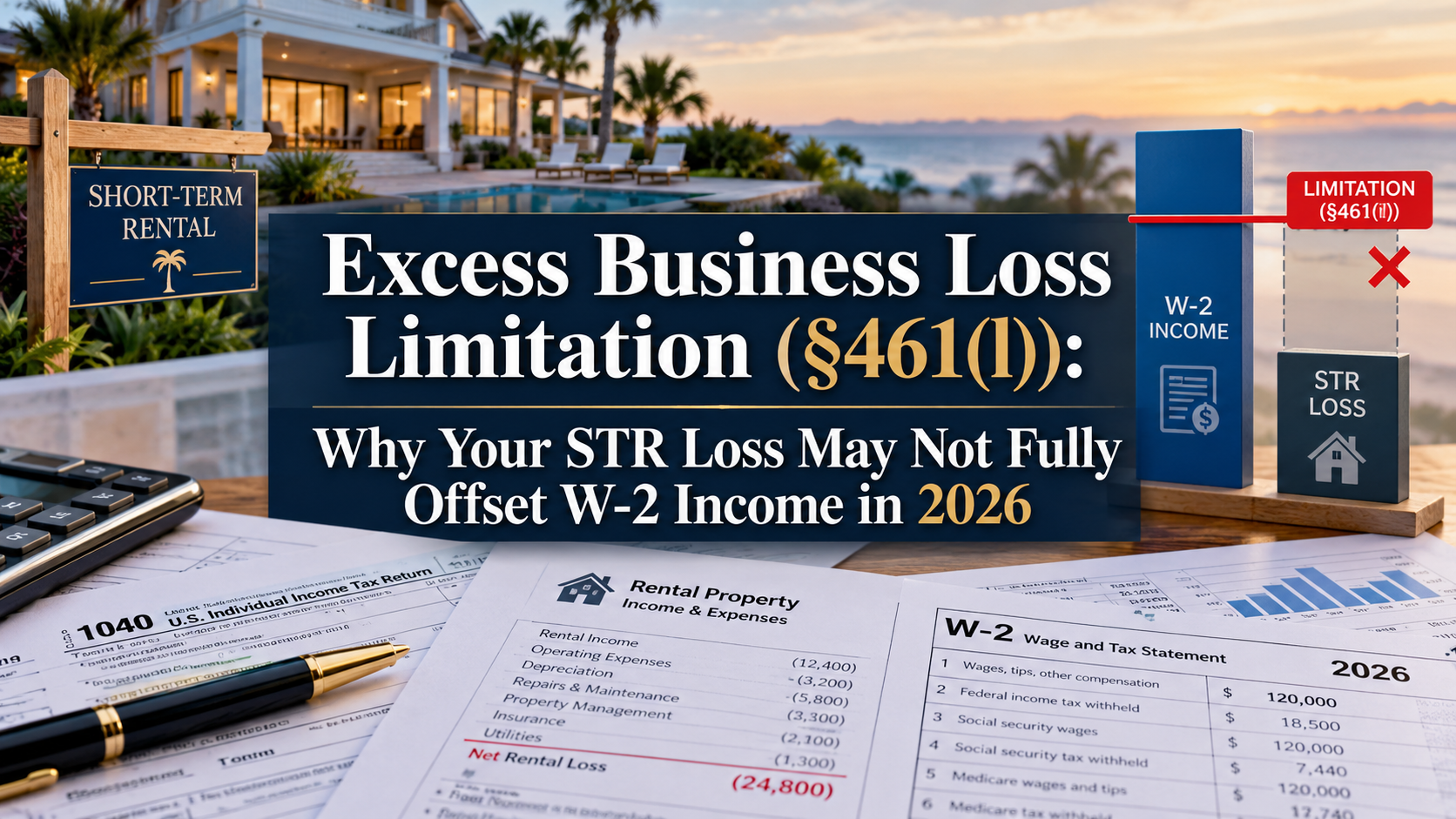
| Excess business losses | IRC §461(l) limitations | Separate state calculations and carryovers |
These differences matter whether you're a California resident investing elsewhere or an out-of-state owner with a rental property in California.
The California Franchise Tax Board's federal conformity guidance explains the state's relationship to federal tax rules.
For an overview of the federal rules, see our guide to short-term rental taxation.
California and Bonus Depreciation (Form FTB 3885A)
Bonus depreciation is one of the biggest reasons federal and California Airbnb tax deductions may differ.
Federal law generally allows 100% bonus depreciation for eligible property acquired after January 19, 2025, subject to applicable requirements.
This can include certain furniture, appliances, equipment, and shorter-lived property components.
However, California doesn't conform to federal bonus depreciation under IRC §168(k), as reflected in California Revenue and Taxation Code §17250.
Can You Claim Bonus Depreciation in California?
No. California generally requires separate depreciation calculations instead of allowing the federal bonus deduction.
For example, suppose your Airbnb has $80,000 in assets eligible for federal 100% bonus depreciation.
You may be able to deduct that amount immediately on your federal return. California, however, may allow a much smaller depreciation deduction during the same year.
The remaining allowable California depreciation may be recovered over future years.
This means federal tax savings can arrive earlier than California tax savings.
Our guide to federal bonus depreciation explains eligible assets and deduction requirements. You can also review the IRS Form 4562 instructions.
How Cost Segregation and FTB 3885A Work Together
A cost segregation study identifies building components, furnishings, and improvements that may qualify for shorter depreciation periods.
This can accelerate federal deductions, but California requires its own calculations.
Form FTB 3885A, Depreciation and Amortization Adjustments, helps applicable individual taxpayers reconcile differences between federal and state depreciation.
Suppose an investor claims $60,000 in federal depreciation but only $12,000 in California depreciation.
That creates a $48,000 difference requiring appropriate state tax reporting.
The FTB 3885A instructions explain how these adjustments are calculated.
Cost segregation isn't automatically worthwhile for every property. The benefit depends on qualifying assets, study costs, and whether the owner can actually use the deductions.
Our analysis of whether cost segregation is worth it for an Airbnb explores those considerations.
California Section 179 Has Lower Limits
Section 179 allows eligible taxpayers to deduct the cost of certain qualifying property rather than depreciating it over several years.
However, California generally limits its Section 179 deduction to $25,000, with a phaseout beginning when qualifying property placed in service exceeds $200,000.
Federal limits are considerably higher.
For Airbnb investors, Section 179 isn't an automatic replacement for bonus depreciation. The amount allowed depends on asset eligibility, business use, and applicable income limitations.
California Passive Loss Rules and the STR/REPS Strategy
Another important question is whether an Airbnb loss can reduce income from a regular job.
Rental activities are generally passive for tax purposes. However, certain short-term lodging activities can qualify for different treatment.
Does the STR Loophole Work in California?
Yes, qualifying short-term rental activities may receive nonpassive treatment in California.
Under Treasury Regulation §1.469-1T(e)(3)(ii), an activity with average guest stays of seven days or less may fall outside the definition of a rental activity for passive loss purposes.
Other exceptions can apply, including certain stays averaging 30 days or less when significant personal services are provided.
But meeting a short-stay exception alone isn't enough.
The taxpayer must also establish material participation to treat a qualifying trade or business activity as nonpassive.
One potential test requires more than 500 hours of participation. Another may apply when the owner works more than 100 hours, and no other individual participates more.
When the requirements are met, qualifying losses may potentially offset W-2 income, subject to additional limitations.
Our explanation of federal passive activity loss rules covers these tests and suspended losses.
Why California Treats Real Estate Professionals Differently
Real estate professional status, or REPS, is different from the STR loophole.
Federally, qualifying real estate professionals may receive nonpassive treatment for certain rental real estate activities under IRC §469(c)(7), provided they satisfy the applicable requirements.
California doesn't recognize that federal exception.
Therefore, an investor who qualifies as a real estate professional federally cannot automatically deduct the same rental real estate losses against W-2 income on a California return.
However, qualifying short-term lodging activities may still receive nonpassive treatment through a separate rental-activity exception.
Our guide to real estate professional status explains the federal distinction.
What Happens to Rental Losses You Can't Deduct?
When California treats a loss as passive, it generally can't offset wages or unrelated nonpassive income.
Instead, the unused amount may become a suspended passive activity loss.
For example, an investor with a $35,000 passive rental loss and no qualifying passive income may need to carry the disallowed amount into future years.
Those losses may become available against future passive income or under applicable disposition rules.
Because California and federal depreciation can differ, investors should maintain separate suspended loss records.
See the FTB 3801 instructions for California passive activity loss calculations.
Worked Example: Federal Loss vs. CA Taxable Income
Let's see how these differences can affect an investor.
Suppose a California resident buys a furnished Airbnb in 2026, qualifies for federal bonus depreciation, and meets the applicable STR and material participation requirements.
Their first-year results might look like this:
| Income or Expense | Federal Return | California Return |
|---|---|---|
| Rental revenue | $85,000 | $85,000 |
| Operating expenses | ($55,000) | ($55,000) |
| Income before depreciation | $30,000 | $30,000 |
| Depreciation | ($120,000) | ($22,000) |
| Net rental result | ($90,000) | $8,000 |
Illustrative example only. Depreciation amounts are assumed and do not represent a specific taxpayer's return.
The federal return shows a $90,000 rental loss, while California reports $8,000 in positive rental income.
That's a $98,000 difference in the first-year rental results.
How This Affects First-Year Tax Savings
Assume the investor has a 35% federal marginal income tax rate and a 9.3% California marginal rate.
If the full federal loss is deductible against income taxed at 35%, the potential federal tax savings could reach $31,500.
Meanwhile, the $8,000 in California rental income could result in approximately $744 in additional state income tax.
The combined illustrative tax effect would be $30,756.
Actual savings depend on income, tax brackets, credits, and additional deduction limitations.
These tax calculations also shouldn't be confused with rental cash flow. Mortgage payments, furnishings, repairs, and other expenses still affect the property's overall profitability.
The main takeaway: A large federal deduction doesn't guarantee equally large California tax savings.
Out-of-State Owners of California STRs
You don't need to live in California to have California income tax obligations.
Rental income from real estate located in California is generally considered California-source income.
Do You Owe California Tax If You Live Elsewhere?
Potentially, yes.
For example, a Texas resident who owns an Airbnb in Palm Springs may need to file a California tax return, even though Texas doesn't impose an individual state income tax.
Nonresidents with California filing obligations generally use Form 540NR.
California residents, meanwhile, generally report income from all sources, including rental properties in other states.
When multiple states tax the same income, an other-state tax credit may be available, depending on applicable rules.
The California Form 540NR instructions explain nonresident filing requirements.
Investors owning properties in multiple states should separately track rental income, depreciation, and unused losses.
Local Transient Occupancy Taxes
Beyond income taxes, California Airbnb owners may face local transient occupancy tax (TOT), sometimes called lodging tax or hotel tax.
These charges generally apply to qualifying short-term guest stays and are separate from federal and state income taxes.
There is no single statewide occupancy tax rate for every California Airbnb.
How City and County Taxes Work
City taxes and county taxes depend on the rental property's exact location.
For example, Los Angeles generally applies a 14% transient occupancy tax to covered lodging transactions, while other jurisdictions establish their own rates.
Local rules can also determine whether cleaning fees or other guest charges are included in the taxable amount.
Hosts should verify current requirements with the relevant local government before collecting taxes.
Does Airbnb Collect and Remit Taxes Automatically?
Airbnb collects and remits certain occupancy taxes in participating jurisdictions.
However, this doesn't necessarily cover every tax obligation.
Hosts may still need to register with the local tax authority, file periodic occupancy tax returns, collect taxes on direct reservations, and maintain accurate records.
Airbnb's California occupancy tax collection guide identifies participating jurisdictions.
Owners should also check whether local permits, business licenses, or other lodging requirements apply.
What About Property Tax and Sales Tax?
Property tax generally applies to California real estate, while certain business equipment or furnishings may raise personal property assessment issues.
California sales tax is a separate consideration. Ordinary lodging charges generally aren't treated the same as retail sales, although separately sold goods or other transactions may create different obligations.
These issues should be evaluated separately from transient occupancy taxes.
Planning Tips for California Investors
Effective tax preparation for Airbnb hosts in California means looking beyond federal deductions.
Investors should understand the effects of state depreciation differences, passive losses, and local tax compliance before filing.
Keep Separate Depreciation Records
Track each property's federal and California depreciation, adjusted basis, and unused rental losses.
This becomes especially important when selling a property.
Federal bonus depreciation may reduce federal adjusted basis faster than California depreciation reduces state basis. As a result, the taxable gain and depreciation recapture calculations can differ.
Our guide to depreciation recapture when selling a short-term rental explains how earlier deductions can affect future taxes.
Document Material Participation
If you're using the STR loophole, maintain reliable records of qualifying activities.
Guest communication, maintenance, and operational management may count, depending on the circumstances.
Not every ownership task qualifies, so records should reflect actual work rather than general estimates.
Understand Excess Business Loss Rules
Even when a rental activity qualifies as nonpassive, additional loss limitations may apply.
IRC §461(l) limits excess business losses for certain noncorporate taxpayers. California applies separate calculations and carryover rules.
After other applicable limitations are considered, Form FTB 3461 may be required.
Federally, disallowed excess business losses generally become part of a net operating loss carryforward. California instead treats disallowed amounts as separate excess business loss carryovers under state rules.
This can affect when the deductions become available.
The California Schedule CA instructions provide additional information about state adjustments and business loss treatment.
Review Your Overall Tax Position
Airbnb tax prep for California investors should consider depreciation, participation requirements, rental losses, income sourcing, and local tax compliance together.
A strategy that produces substantial federal savings may still lead to a different California result.
Reviewing both returns helps investors understand the timing of deductions and their potential effect on long-term investment returns.
Understanding Your Federal and California Tax Results
California Airbnb taxes involve more than rental income and operating expenses.
Federal bonus depreciation, cost segregation, and the STR loophole may create substantial deductions. However, California's separate depreciation rules, passive activity limitations, and local tax requirements can change the amount and timing of those benefits.
Maintaining accurate records and understanding the differences between federal and state treatment can make annual filing more manageable and help investors make informed decisions throughout the life of their rental property.
Disclaimer: This article is for general educational purposes only and does not constitute individualized tax, accounting, or legal advice. Consult a qualified CPA, enrolled agent, or tax professional about your specific circumstances.
Frequently Asked Questions
How Much Tax Will I Pay on My Airbnb?
It depends on rental income, deductible expenses, overall taxable income, and the property's location. Federal and California income taxes are separate from local occupancy taxes, so the total varies.
What Is the Airbnb Tax Loophole?
The STR loophole refers to rules that may allow qualifying short-term lodging activities to be treated as nonpassive when applicable rental-activity exceptions and material participation requirements are satisfied.
Can I Take Bonus Depreciation in California?
No. California doesn't conform to federal bonus depreciation under IRC §168(k). Qualifying assets may receive immediate federal deductions but generally require separate California depreciation calculations.
Can Airbnb Losses Offset W-2 Income?
Potentially. Losses from a qualifying nonpassive activity may offset other income, subject to basis, at-risk, excess business loss, and other applicable limitations.
Do Out-of-State Airbnb Owners Owe California Taxes?
Possibly. Nonresidents with taxable California-source rental income may have California filing and income tax obligations.
Does Airbnb Automatically Pay Occupancy Taxes?
Airbnb collects certain local occupancy taxes in participating jurisdictions, but hosts may retain registration, filing, or additional payment obligations.
What Is FTB 3885A?
FTB 3885A helps calculate depreciation and amortization adjustments when federal and California deductions differ.
Is Cost Segregation Worth It for California Airbnb Investors?
It can be. Cost segregation may provide accelerated federal deductions, even though California doesn't allow the same bonus depreciation treatment. Its value depends on qualifying assets, study costs, and the investor's tax circumstances.